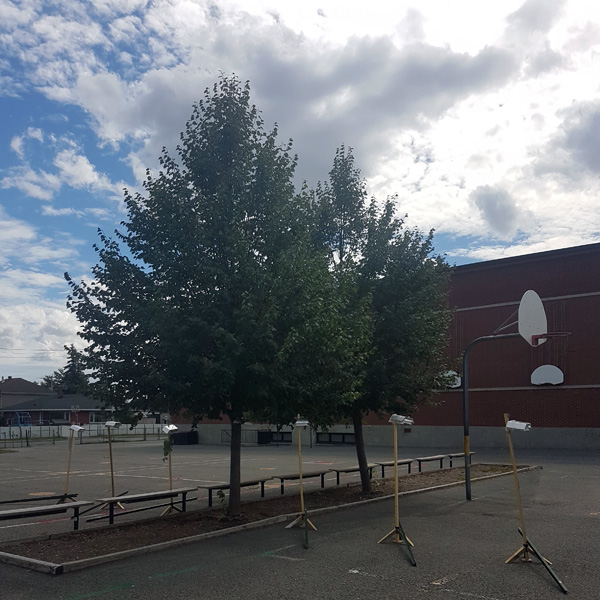
Heat islands are becoming a growing health risk for citizens in urban areas. In partnership with the City of Laval, this project aims to better understand how, and over how great a distance, can trees help lower surface temperatures. In addition, we are interested in understanding any difference in effects between different surface types (asphalt vs grass). The research focuses on areas, such as school yards, which would benefit citizens of higher risk (ex. children). We are installing temperature sensors around trees, on both asphalt and grass, and measuring fine-scale temperature changes. The goal is to provide the city with a more precise model on how trees benefit their citizens, and how demineralization (transformation of asphalt into grass or green spaces) can help amplify these benefits.